

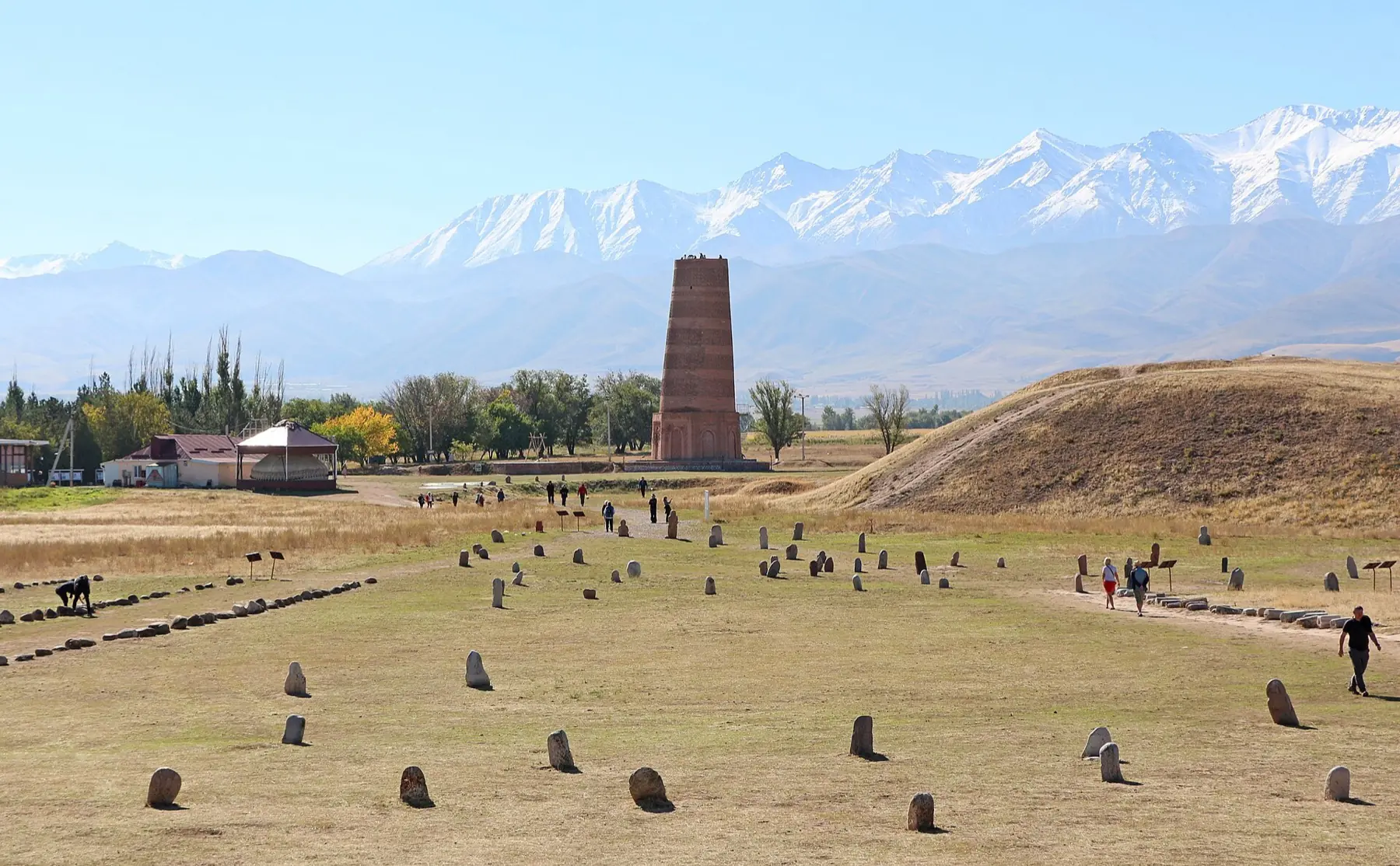
Beyond Tokmok, among the fields of the Chuy Valley, stands the brick tower of Burana. From a distance it looks solitary. Come closer and low walls, earthworks and rows of stone figures appear. This was Balasagun, a Silk Road city and one of the Karakhanid capitals. The tower survives from a time when workshops and markets operated around it and people were called to prayer.
Balasagun, a city on the road
Balasagun grew on an older settlement. A city had taken shape by the tenth century. After the Karakhanid state split, Balasagun and Kashgar were both capitals of the eastern khanate. The Chuy Valley lay on the northern Silk Roads, along which merchants carried goods and shared knowledge, languages and customs.
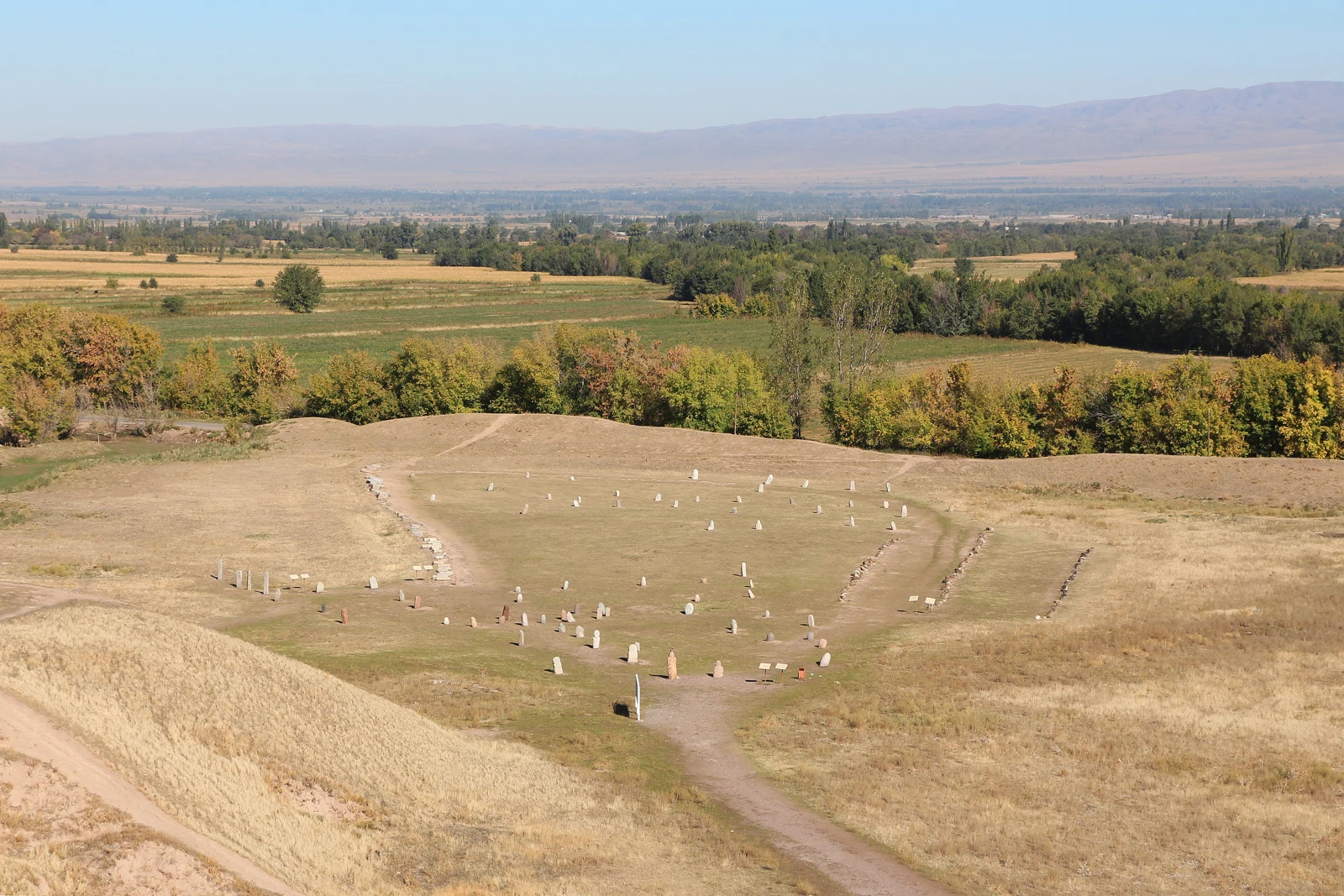
Excavations have revealed traces of two lines of walls, a fortress, homes, workshops, markets and a bathhouse. Pipes brought water from a neighbouring gorge. Stand by the low banks and picture their walls at full height: it is easier to see how a lone tower in a field once belonged to a large city.
The eleventh-century poet Yusuf Balasaguni is associated with the city. His Kutadgu Bilig is an early major work of Turkic literature. Its characters discuss government, justice and the role of knowledge. Few buildings remain, yet those conversations can still be read today.
Why the tower was built
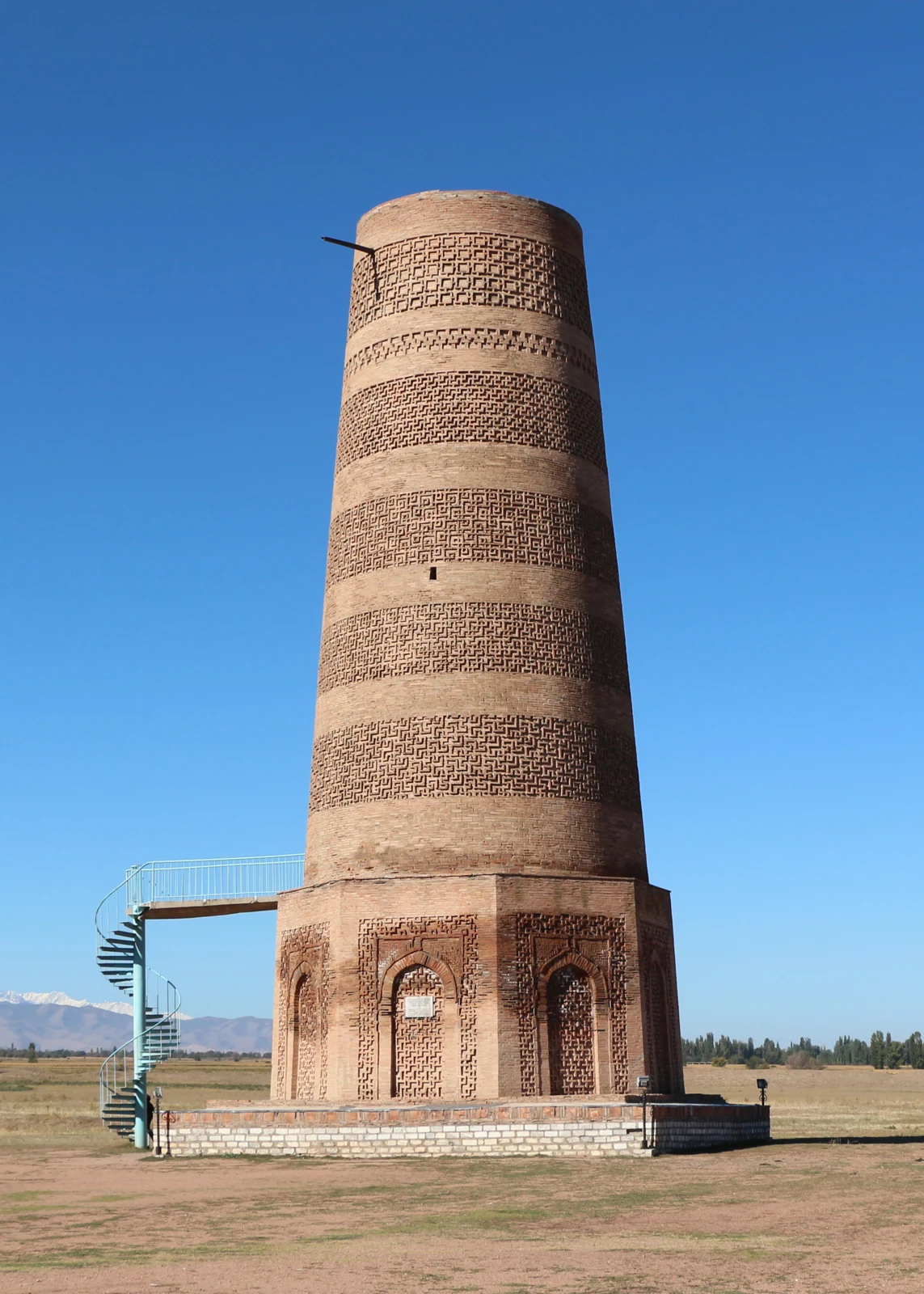
Burana is usually dated to around the turn of the eleventh century. It is a minaret, a tower of the kind used at mosques to call people to prayer. Researchers believe Balasagun’s mosque stood west of the tower. No complete mosque building survives there.
Walk around the minaret and look at the brickwork. Arches decorate the broad base, while bands of brick patterns wrap around the shaft. Each band has a different design. Sunlight casts small shadows from the raised bricks and brings out the detail.
The original height is estimated at about 45 metres. The upper part collapsed, damage associated with earthquakes. The tower was restored in the 1970s. Its present height is 21.7 metres. About half of the former tower stands, still visible from far away.
A city under changing rulers
In the twelfth century Balasagun became the capital of Western Liao, also known as the Qara Khitai state. Mongol rule followed in the early thirteenth century. The city remained inhabited in the fourteenth century and later declined. The sources do not give an exact date for its final abandonment.
Twentieth-century excavations and conservation brought the city’s outlines back into view. In 2014 Balasagun joined the UNESCO World Heritage List as part of the Chang’an–Tianshan Corridor. The same network includes two other Chuy Valley sites: Suyab at Ak-Beshim and Nevaket at Krasnaya Rechka. Burana is one stop along a road you can still trace through its cities.
The stones around the minaret
Start at the mausoleum foundations. The low brickwork shows the shapes of buildings raised above graves. Then walk to the stone figures. The open-air display commonly calls them balbals. Look for carved faces, hands and cups. The stones came from different places; some predate the Karakhanid period.
Take time to notice a moustache on one figure or a vessel held in front of another. There are also rocks with carvings and old millstones. Inside the museum, pottery and other excavated objects give a closer look at everyday life.
The legend of the khan’s daughter
In one version of the story, a khan was told his daughter would die from a spider bite. He housed her in a high tower to keep her safe. One day she was brought grapes. A spider hid among them, and the prediction came true.
The legend has several versions. It tells of a father trying to protect his daughter. The building has its own history, visible in the bricks of the minaret and in the objects excavated around it.
Visiting Burana
The site is near Tokmok in the Chuy Valley. Allow a separate half-day trip from Bishkek. If travelling via Tokmok, arrange your return with your driver before setting out. Check opening hours, admission and whether the tower stairs are open on your date; the stairs inside are narrow and dark.
There is a day trip from Bishkek to the tower: Burana, Kegeti, Issyk-Ata by DI Travel KG covers the minaret, the Kegeti gorge and Issyk-Ata in one outing. The tour page lists 10 hours and KGS 1,400 (about US$16) per person, including the return transfer from Bishkek and a group leader; meals are paid separately and the minimum age is 18. The price was checked on 14 November 2026; the page does not show new departure dates yet, so agree your day with the operator. Other one-day trips are in the day trips and tours from Bishkek collection.
Give yourself time to walk around the tower, see the stone figures and visit the museum. For an overnight stop there is a hotel in Tokmok. If returning to the capital, see our guide to things to see in Bishkek.
Frequently asked questions
How long does the trip take? From Bishkek, it works well as a separate half-day outing. That is enough to walk around the minaret, look at the stone figures and visit the museum. If you travel via Tokmok, agree the return journey with your driver in advance.
Can I climb the tower? The climb is not always open, so check that before you set out, along with the opening hours and the ticket price. Inside is a narrow, dark staircase.
How tall is the tower? Its original height is estimated at about 45 metres. The upper part collapsed, which is attributed to earthquakes; the tower was restored in the 1970s. It now stands 21.7 metres — roughly half of what it was, and even that is visible from far off.
What are the stone figures beside it? In the open-air museum they are usually called balbals: among them are carvings with faces, hands and bowls. These monuments were brought together from various places, and some date from before the Karakhanids. Nearby lie stones with carvings and old millstones.
Is the legend of the khan's daughter true? It is a folk tale, told in several versions: the khan was warned his daughter would die of a spider bite, so he housed her in a high tower, but a spider came in with a bowl of grapes. The history of the building itself is read elsewhere — in the brickwork of the minaret and in what archaeologists found around it.
Photos: Bgag, CC0. Minaret · Stone stelae. Images resized without cropping.


no comments