


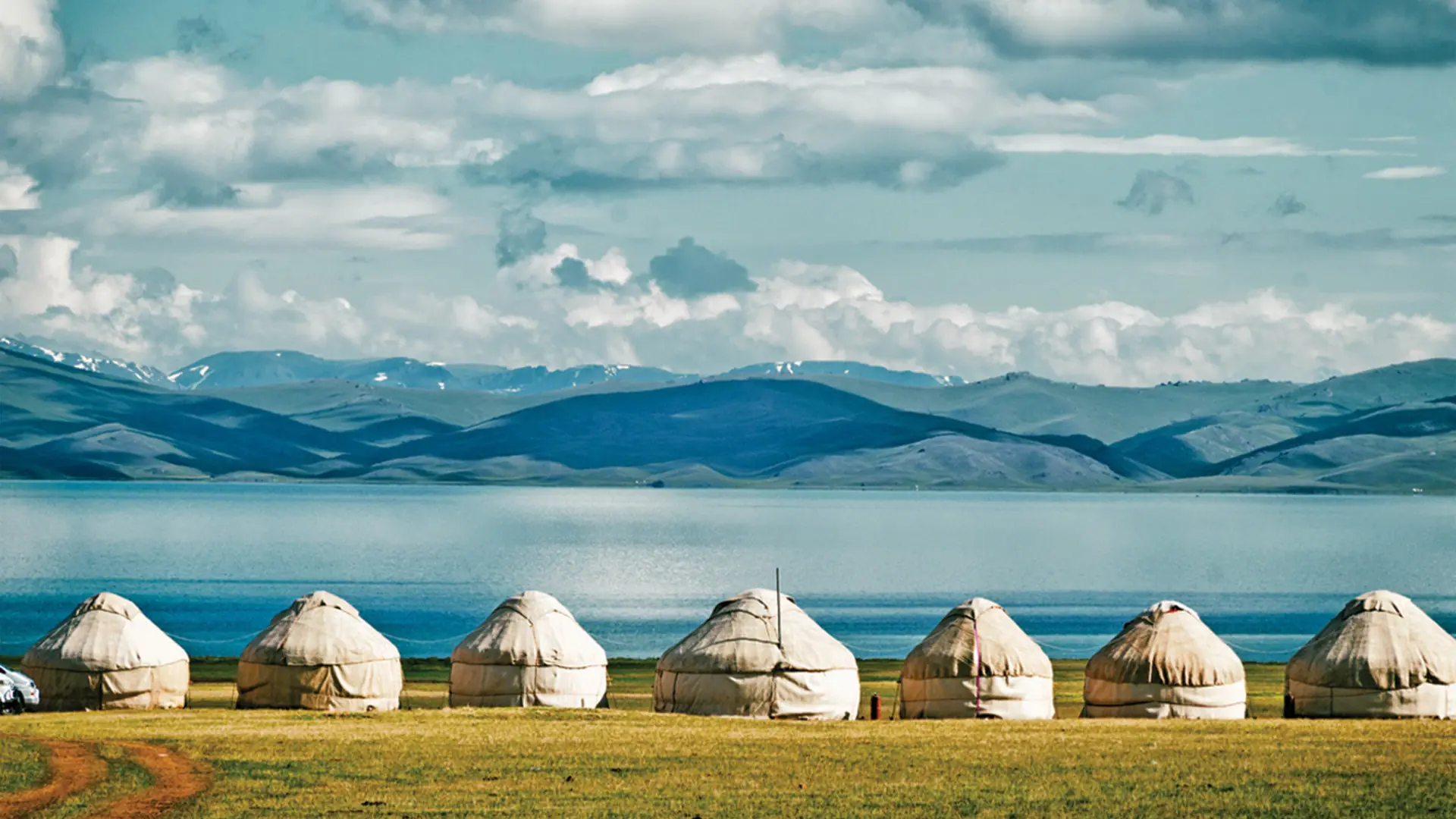
You step out of a yurt in the morning. In front of you are pasture, horses and a lake, with mountains rising beyond it. Today you could go for a horse ride, or stay by the water. In the evening, return beneath the felt roof, then step outside once more to look at the sky before bed.
That is one way to spend a summer trip to Song-Kul. But it is only one way to see Kyrgyzstan. People come to hike to mountain lakes, swim in Issyk-Kul, explore valleys and ski in Karakol in winter. Between them are towns, villages and roads where you may find yourself stopping more often than you planned.
A country you get to know on the road
Kyrgyzstan is in Central Asia, between Kazakhstan, Uzbekistan, Tajikistan and China. Almost 90% of its territory lies above 1,500 metres. Mountains shape both the landscape and the journey: a bend in the road reveals a gorge; beyond a pass, another valley begins.
Your trip might start in Bishkek, walking streets lined with trees and irrigation channels. Then head towards Issyk-Kul, Karakol or the pastures of Naryn Region. Along the way, more than the view changes: city hotels give way to guest houses, and further on you could stay in a yurt.
You do not need to take on a difficult trek to get to know the country. Some trips combine short walks with nights in towns and villages. Others involve carrying a backpack for several days and waking up in the mountains. Choose the kind of journey you enjoy.
Mountains: from a valley walk to a lake beyond the pass
Ala-Archa is near Bishkek. It offers a first introduction to the mountains: visit the valley, go for a walk and return to the city. Climbers will also find rock and ice routes in the area. Difficulty depends on the route you choose; the same valley can offer very different experiences.
In the east, Karakol is a starting point for exploring the Terskey Ala-Too mountains, including Ala-Kul, a lake at 3,532 metres.
A trip to Ala-Kul needs more preparation. The approach takes you into high mountain terrain, and a route crossing the pass reaches 3,860 metres. Plan this part of your holiday separately, taking account of experience, weather and time to adjust to altitude.
But a visit to Kyrgyzstan does not have to include a high pass. You can choose valleys, shorter walks and roadside views, and leave a longer trek for another visit.
Issyk-Kul: beaches, canyons and nearby mountains
Issyk-Kul lies at 1,607 metres. There is water at the shore and mountain ranges beyond it. In summer, you can spend a swimming holiday here or make the lake part of a wider journey.
Cholpon-Ata and Bosteri are on the northern shore, with holiday resorts, hotels and guest houses. This side suits a trip centred on time by the water.
The southern shore offers other reasons to stop. Skazka, or Fairy Tale Canyon, has red-orange ridges that stand out in low sunlight. Families in Kyzyl-Tuu make yurts; in Bokonbaevo, visitors explore the tradition of eagle hunting. Closer to Karakol are the red rock formations of Jeti-Oguz.
You can combine these experiences with time at the lake. One day by the water, another in a canyon or a village of craftspeople. Nature and culture can share the same holiday.
Jailoo: a different rhythm of life
A jailoo is a summer mountain pasture. Families bring livestock up, put up yurts and spend part of the summer there. As a traveller, you arrive somewhere seasonal life is already underway.
At Song-Kul, 3,016 metres above sea level, pastures surround the lake. People come for horse riding and nights in yurts, but leave some time without activities too. Sit beside the water, watch horses spread across a slope, wait for evening.
A night in a yurt is an experience of its own: felt, a circular wooden frame, a space without the rooms you are used to. Facilities differ between camps, so ask about sleeping arrangements, heating and toilets before booking.
In Kyzyl-Tuu, you can also learn how a yurt is made. Afterwards, its frame and felt roof may look different to you: you begin to notice the work of the hands that made them.
History you can see
It is easy to include history in a trip around Kyrgyzstan. Burana Tower, about 80 kilometres from Bishkek, is the surviving minaret of medieval Balasagun, a city on the Silk Road.
In Naryn Region, Tash Rabat is a stone building at roughly 3,200 metres, usually described as a caravanserai. Visitors come to see its old walls among the mountains and imagine the road once travelled by caravans.
In the south is Osh, with Sulayman-Too rising above it. The mountain is a UNESCO World Heritage Site. This is another side of the country to explore on a separate trip or as part of your route.
Culture also lives in the sound of language. Performers known as manaschi recite the Manas epic in a rhythmic chant without musical accompaniment. If you have a chance to listen, voice and rhythm offer a way into the tradition even without understanding every word.
When to visit
Start with what you want to see. There is no single best month for every trip.
What you want to do | When to plan |
|---|---|
High mountain trekking | Usually July–September; check conditions on individual passes |
Song-Kul, yurt stays and horse riding | July and August are a starting point; confirm camp opening dates |
A summer stay at Issyk-Kul | June–August |
Canyons, lower routes and town walks | Spring and autumn, depending on weather |
Skiing | Winter; resort opening dates depend on snow |
September can suit a combination of mountains and travel around the country. But if a particular pass or yurt camp is the main reason for coming, plan around conditions there.
Before your first trip
For many journeys, Bishkek and Manas Airport are a convenient starting point. For the south, consider flying into Osh. Travel within the country is usually by road: allow extra time for mountain roads and stops.
The currency is the Kyrgyz som, abbreviated KGS. Carry cash for travel beyond the cities, and ask small guest houses and local transport providers which payment methods they accept. Kyrgyz and Russian are used in the country; if you need service in English, confirm it with your accommodation or guide in advance.
For high mountain routes, plan preparation and acclimatisation around their altitude and difficulty. Check entry requirements for your nationality, permitted length of stay and registration rules separately.
Arrange these things before setting off, leaving more time to look around during the trip.
Where to stay
Choose accommodation around the part of the country you want to explore. For trekking above Karakol, consider a guest house in town. For a journey around Issyk-Kul, choose stops on the shore that suits your plans. For arrival night or before a flight, look at a hotel or apartment in Bishkek.
On Meiman, browse guest houses in Karakol, accommodation at Issyk-Kul, yurts at Issyk-Kul and places to stay in Bishkek.
Check location, facilities and prices for your dates before booking. For a yurt, ask about meals and bathroom facilities; for a guest house before a trek, ask whether you can leave belongings while you are away.
You send a booking request and the host confirms it. After confirmation, you have two hours to pay the deposit with a Visa card on the bank’s secure payment page; the balance is paid at check-in. See the booking guide for details.
For a first visit, choose something you particularly want to experience: a lake beyond a pass, a few nights in a yurt, or time at Issyk-Kul with walks nearby. Leave some space between your plans. An unplanned stop may turn out to be the part you remember most.
'/%3e%3cpath%20fill-rule='evenodd'%20clip-rule='evenodd'%20d='M12%207.5C9.519%207.5%207.5%209.519%207.5%2012C7.5%2014.481%209.519%2016.5%2012%2016.5C14.481%2016.5%2016.5%2014.481%2016.5%2012C16.5%209.519%2014.481%207.5%2012%207.5ZM12%2014.3205C12.3047%2014.3205%2012.6065%2014.2605%2012.888%2014.1439C13.1696%2014.0272%2013.4254%2013.8563%2013.6408%2013.6408C13.8563%2013.4254%2014.0272%2013.1696%2014.1439%2012.888C14.2605%2012.6065%2014.3205%2012.3047%2014.3205%2012C14.3205%2011.6953%2014.2605%2011.3935%2014.1439%2011.112C14.0272%2010.8304%2013.8563%2010.5746%2013.6408%2010.3592C13.4254%2010.1437%2013.1696%209.97275%2012.888%209.85614C12.6065%209.73952%2012.3047%209.6795%2012%209.6795C11.3846%209.6795%2010.7943%209.92398%2010.3592%2010.3592C9.92398%2010.7943%209.6795%2011.3846%209.6795%2012C9.6795%2012.6154%209.92398%2013.2057%2010.3592%2013.6408C10.7943%2014.076%2011.3846%2014.3205%2012%2014.3205Z'%20fill='url(%23paint1_radial_14795_49782)'/%3e%3cpath%20fill-rule='evenodd'%20clip-rule='evenodd'%20d='M15.375%203H8.625C7.13316%203%205.70242%203.59263%204.64752%204.64752C3.59263%205.70242%203%207.13316%203%208.625V15.375C3%2016.8668%203.59263%2018.2976%204.64752%2019.3525C5.70242%2020.4074%207.13316%2021%208.625%2021H15.375C16.8668%2021%2018.2976%2020.4074%2019.3525%2019.3525C20.4074%2018.2976%2021%2016.8668%2021%2015.375V8.625C21%207.13316%2020.4074%205.70242%2019.3525%204.64752C18.2976%203.59263%2016.8668%203%2015.375%203ZM15.411%2018.7395C16.2942%2018.7395%2017.1412%2018.3887%2017.7657%2017.7642C18.3902%2017.1397%2018.741%2016.2927%2018.741%2015.4095V8.5905C18.741%207.70733%2018.3902%206.86033%2017.7657%206.23583C17.1412%205.61134%2016.2942%205.2605%2015.411%205.2605H8.589C7.70583%205.2605%206.85883%205.61134%206.23433%206.23583C5.60984%206.86033%205.259%207.70733%205.259%208.5905V15.4125C5.259%2016.2957%205.60984%2017.1427%206.23433%2017.7672C6.85883%2018.3917%207.70583%2018.7425%208.589%2018.7425L15.411%2018.7395Z'%20fill='url(%23paint2_radial_14795_49782)'/%3e%3cdefs%3e%3cradialGradient%20id='paint0_radial_14795_49782'%20cx='0'%20cy='0'%20r='1'%20gradientUnits='userSpaceOnUse'%20gradientTransform='translate(7.78215%2022.3861)%20rotate(-90)%20scale(17.8392%2016.5919)'%3e%3cstop%20stop-color='%23FFDD55'/%3e%3cstop%20offset='0.1'%20stop-color='%23FFDD55'/%3e%3cstop%20offset='0.5'%20stop-color='%23FF543E'/%3e%3cstop%20offset='1'%20stop-color='%23C837AB'/%3e%3c/radialGradient%3e%3cradialGradient%20id='paint1_radial_14795_49782'%20cx='0'%20cy='0'%20r='1'%20gradientUnits='userSpaceOnUse'%20gradientTransform='translate(7.782%2022.386)%20rotate(-90)%20scale(17.8392%2016.592)'%3e%3cstop%20stop-color='%23FFDD55'/%3e%3cstop%20offset='0.1'%20stop-color='%23FFDD55'/%3e%3cstop%20offset='0.5'%20stop-color='%23FF543E'/%3e%3cstop%20offset='1'%20stop-color='%23C837AB'/%3e%3c/radialGradient%3e%3cradialGradient%20id='paint2_radial_14795_49782'%20cx='0'%20cy='0'%20r='1'%20gradientUnits='userSpaceOnUse'%20gradientTransform='translate(7.782%2022.386)%20rotate(-90)%20scale(17.8392%2016.592)'%3e%3cstop%20stop-color='%23FFDD55'/%3e%3cstop%20offset='0.1'%20stop-color='%23FFDD55'/%3e%3cstop%20offset='0.5'%20stop-color='%23FF543E'/%3e%3cstop%20offset='1'%20stop-color='%23C837AB'/%3e%3c/radialGradient%3e%3c/defs%3e%3c/svg%3e)


no comments